
8 traditional Brazilian dishes and their stories
The richness of Brazilian cuisine reflects the country's cultural and historical diversity. traditional brazilian dishes They are living legacies of indigenous, African and European influences, each with a fascinating history that goes beyond flavor.
Adverts
In this text, we will highlight eight of these delights, delving into their origins and meanings. So, be sure to follow along!
1. Feijoada: symbol of the union of cultures

A feijoada It is one of the most iconic dishes in Brazil. Although many associate it with slave culture, its origins are more complex.
Historically, bean stew with pork dates back to Portuguese cuisine, which adapted similar dishes such as Portuguese stew to Brazilian conditions.
However, in Brazil, the feijoada It gained Afro-Brazilian ingredients, such as black beans and less noble cuts of meat, becoming a reference in national cuisine.
Adverts
Researchers believe that the dish began to become popular in the 19th century, gaining popularity in Rio de Janeiro restaurants as an elite meal.
+ Make a perfect and economical feijoada for 40 people!
A feijoada It is traditionally accompanied by rice, kale, farofa and orange, a combination that balances the richness of the flavors.
“Cuisine is the soul of a people, expressed in the combination of ingredients and seasonings.” — Carlos Lacerda, historian.
| Main ingredients | Historical origin |
|---|---|
| Black beans, pork, rice, farofa | Portuguese and Afro-Brazilian influences |
2. Traditional Brazilian dishes _ Moqueca: the taste of the tropics

A Stew It is a dish that certainly epitomizes Brazilian tropical cuisine. There are two main versions: the Bahian and the Capixaba.
A Bahian moqueca It is distinguished by the use of palm oil and coconut milk, both brought by enslaved Africans.
The Capixaba preserves indigenous influences, with the use of clay pots and lighter seasonings, such as annatto.
This dish, whose base is fish cooked with fresh seasonings, symbolizes the connection of the Brazilian people with natural resources and the sea.
Certainly, the simplicity of the ingredients of the Stew highlights the freshness of coastal cuisine, remaining one of the country's main delicacies.
3. Acarajé: heritage of the African diaspora

O Shrimp bean ball It has its roots in the African continent, more specifically among the Yoruba, who brought this dish to Brazil during the colonial period.
Made with black-eyed pea dough, acarajé is fried in palm oil and served with dried shrimp and vatapá.
In Brazil, acarajé has become a symbol of African cultural resistance and is closely linked to Candomblé.
It is sold on the streets of Salvador, especially by Bahian women dressed in traditional costumes, perpetuating a centuries-old tradition.
4. Traditional Brazilian dishes _ Cheese bread: the comfort of Minas Gerais

O cheese bread, famous in Minas Gerais, is one of the most consumed traditional Brazilian dishes in the country.
Its origins date back to the colonial period, when cooks on Minas Gerais farms adapted Portuguese bread recipes to deal with the lack of wheat.
Using cassava starch, regional cheeses and eggs, they created this delicacy that is now synonymous with breakfast or snacks.
In 2018, a survey by Embrapa identified that Brazil consumes more than 20 thousand tons of cassava starch per year, highlighting the popularity of this dish.
5. Vatapá: the perfect fusion of flavors
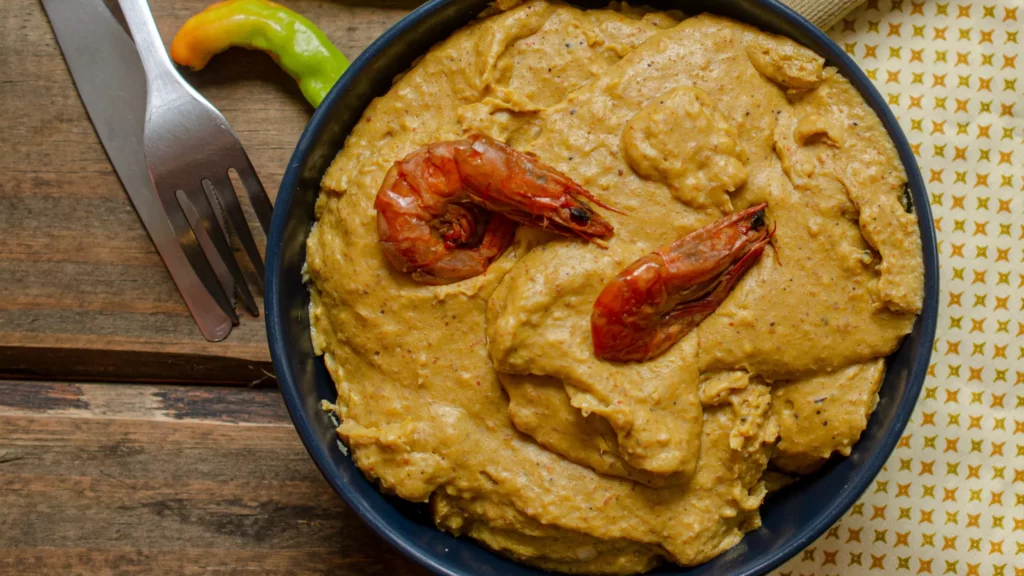
O vatapa It is a typical dish from the Northeast, with a strong African influence, of course.
Made with bread, dried shrimp, peanuts, cashew nuts and coconut milk, vatapá is often served as a side dish for dishes such as acarajé or moquecas.
The presence of intense seasonings and ingredients such as palm oil gives vatapá an unmistakable character, transforming it into one of the traditional brazilian dishes most loved at popular festivals.
6. Traditional Brazilian dishes _ Gaucho barbecue: tradition of fire and meat

O barbecue in Brazil it has its roots in the culture of the pampas, where the gauchos — the cowboys of the south — roasted meat on spits in the open air.
O barbecue Gaucho has become a symbol of southern cuisine and is valued for the simplicity and quality of its meat, seasoned only with coarse salt and slowly roasted over the fire.
Nowadays, barbecue is a tradition throughout Brazil, but its essence remains the same: high-quality meat, fire and friends.
7. Tacacá: Amazonian flavor

O tacaca is an Amazonian delicacy that brings with it the soul of the forest. Made with tucupi (a fermented cassava broth), jambu and dried shrimp, the dish is enjoyed hot, even in the hottest regions of Brazil.
With roots in indigenous cuisine, tacacá symbolizes the fusion of regional flavor with ancestral traditions, being consumed in cultural events and in the daily lives of Amazonian populations.
+ What are the ingredients of Tacacá? Learn the recipe
8. Baião de dois: the essence of the northeastern hinterland
O two-piece baião It is a traditional dish that originated in the northeastern backlands, with a strong indigenous and Portuguese influence.
Originally, it was prepared with rice and beans cooked together, often reusing leftovers.
Over time, it gained additions such as dried meat, coalho cheese, butter and various seasonings, transforming it into one of the most beloved recipes in the region.

The story of two-piece baião It goes back to the difficulties faced by the country people, who needed to create nutritious and easy-to-prepare dishes in a scenario with few resources.
The recipe, therefore, is seen as a representation of northeastern creativity and the ability to do a lot with a little.
At typical festivals, such as São João, baião de dois is a guaranteed presence, reaffirming its role in popular culture and in Brazil's gastronomic identity.
It transcended the backlands and became a national classic, being found in restaurants across the country, especially in establishments that value regional cuisine.
| Main ingredients | Historical origin |
|---|---|
| Rice, beans, dried meat, curd cheese, ghee | Indigenous and Portuguese influence |
The cultural value of traditional Brazilian dishes
Brazilian cuisine is a reflection of its history and geography, with its dishes featuring a fusion of different cultures and local ingredients, of course.
Each region of Brazil has its own typical dishes, which tell stories of struggle, resilience and adaptation to natural conditions.
From North to South, the traditional brazilian dishes are celebrated not only for their flavor, but for the richness of their origins and symbolism.
However, the diversity of ingredients, such as cassava, beans, dried meat and seafood, is a striking characteristic of national cuisine.
These ingredients, many of which were present in indigenous food before the arrival of colonizers, are combined with European and African techniques and influences, resulting in a cuisine that is unique in the world.
The globalization of Brazilian cuisine
With the growth of international interest in gastronomy, many of the traditional brazilian dishes have gained prominence outside the country.
For example, feijoada, cheese bread and moqueca restaurants are spread around the world, bringing the flavor of Brazil to other cultures.
In fact, in 2019, the feijoada was chosen as one of the 50 most iconic dishes in the world by CNN Travel, highlighting its role as an ambassador for Brazilian cuisine abroad.
Furthermore, Brazil has invested in movements to preserve and value its culinary traditions.
In some regions, such as Pará, Amazonian dishes such as tacacá and duck in tucupi have been rescued and presented as cultural heritage.
Preservation of gastronomic identity
The preservation and promotion of traditional brazilian dishes are essential to keeping the country's cultural roots alive.
In an increasingly globalized world, where new gastronomic trends are constantly emerging, valuing Brazilian cuisine is essential to preserving national identity.
Movements such as “slow food” have helped in this process, highlighting the importance of regional foods and traditional preparation methods.
The curiosity to discover more about these recipes grows as you learn more about their stories and cultural roots.
So, learning about the origin of each dish not only enriches knowledge about Brazil, but also awakens a new respect for the complexity and uniqueness of its cuisine.
Cuisine as a cultural expression
Ultimately, for Brazilians, food is not just a source of nutrition. It plays a central role in social and cultural life.
Meals are occasions for gathering, celebration and connection. From Sunday lunches with feijoada to street parties with acarajé and vatapá, traditional brazilian dishes unite people, transmitting feelings of belonging and identity.
In short, Brazilian cuisine is a true national heritage, a living expression of the country's history.
With every bite, Brazilians experience not only the flavors, but the cultural heritage that has shaped these dishes over the centuries.
By celebrating this wealth, we also promote the diversity that makes Brazil so special, without a doubt.