
How to Set Up a Self-Service Restaurant Without Spending a Lot
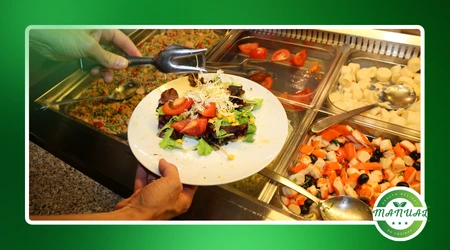
Set up a self-service restaurant can be a financial challenge, but with smart strategies, it is possible to reduce costs without sacrificing quality or customer experience.
Adverts
In a market where 27% of new restaurants close before completing two years (IBGE data, 2024), planning and efficiency are differentiators.
The key word is not just saving, but investing in what really matters: well-thought-out location, strategic menu and lean operation.
Imagine opening a business that serves corporate clients at lunch and families at night, all with the same optimized structure. Sounds complex? In fact, many entrepreneurs are already doing this successfully.
An example is the Quintal Gastrobar, in São Paulo, which started in a 90m² space and today has a monthly turnover of R$120,000 with a premium self-service model.
Adverts
In this guide, we go beyond the basics. You’ll learn how to choose the best value-for-money vendors, which technology is really worth the investment, and how to create a strong identity even on a budget.
Location Selection and Lean Structure
A fatal mistake when setting up a self-service restaurant is to ignore the potential of emerging neighborhoods.
While a property on Avenida Paulista can cost R$50,000 per month, regions such as Vila Leopoldina (SP) or Barra da Tijuca (RJ) offer heavy traffic for half the price.
The rule is simple: foot traffic does not necessarily mean loyal customers.
Choose locations close to offices, colleges or hospitals, where routine ensures recurring demand.
An example is the Sabor & Cia Restaurant, in Recife, which rented a space previously occupied by a convenience store and renovated only the essentials, spending 30% less than the market average.
Structurally, less is more. Stainless steel countertops, thermal counters and modular shelves do not require expensive renovations.
A useful analogy: just as an efficient car doesn't need a turbocharged engine to run well, a restaurant doesn't require fancy decor to be functional.
Efficient Menu and Cost Control to set up a self-service restaurant
Too much variety is the enemy of profitability. Instead of 50 different dishes, focus on 20 well-executed options, with ingredients that can be reused.
+One Pot Pasta: The Simple and Sustainable Revolution in the Modern Kitchen
A roast chicken, for example, can be used as a salad, sandwich or even as broth for risotto.
Negotiating directly with rural producers also makes a difference. In Minas Gerais, the network Minas Gerais Seasoning reduced costs by 18% by purchasing vegetables from local cooperatives, eliminating intermediaries.
Tools like Fair Market connect small restaurants with family farmers, ensuring lower prices and superior quality.
What about waste? Pre-order systems for special dishes (via WhatsApp or Instagram) help to scale production. If 30 people reserve Friday’s cod, you cook 35 portions, not 80.
Technology as an Ally in Operations
Automating processes is essential for anyone who wants to set up a self-service restaurant with a reduced team.
Applications like GestãoClick allow you to control stock in real time, alerting you when the rice is almost gone or when the oil needs to be changed.
Digital payments are also inevitable. In 2025, 82% of restaurant transactions will be made by Pix or card (Febraban data).
++Zucchini Omelette: Protein and Vegetables to Start Your Day
Those who insist on physical money lose agility and still pay more to deposit the amount in the bank.
A real case: the Gourmet Self-Service Space, in Curitiba, implemented self-service kiosks and saw the average time per customer drop from 8 to 3 minutes. The investment of R$15,000 paid for itself in five months.
Smart, Low-Cost Marketing
Social media is the new business card. Instead of expensive Google ads, invest in short videos showing how the dish of the day is prepared.
A colorful dish, filmed in natural lighting, has 53% more engagement than static photos (Source: Socialinsider, 2024).
Partnerships also work. Offering free breakfast to ride-hailing drivers, for example, can help ensure that they recommend your restaurant to their passengers.
O Home Bistro, in Porto Alegre, did this and increased sales by 22% in the afternoon.
Financial Sustainability and Scalability
A successful self-service restaurant is not one that just survives, but one that generates cash to expand. Detailed spreadsheets should separate fixed costs (rent, salaries) from variable costs (ingredients, packaging).
Lines of credit such as Pronaf Food offer below-market interest rates for small businesses.
And if profit allows, consider a second location in a neighboring neighborhood, sharing the same central kitchen. This is how the chain Chef's Backyard grew from one to five units in three years.
Pricing Strategies to Maximize Profits
Determining the ideal price per kilo in self-service is an art that balances perception of value and profit margin.
+Ground beef recipes that save any meal
Industry research shows that the average price charged in 2025 will vary between R$59.90 and R$89.90 per kilo, depending on the region and target audience.
The secret lies in the so-called “price psychology”: values ending in 9 (e.g.: R$ 67.90) increase sales by up to 12% compared to round numbers, according to a study by the University of Chicago.
A common mistake is to keep prices fixed throughout the week. Implementing “theme days” – such as Chicken Wednesday (with a discount on that item) – attracts different audiences without reducing the overall margin.
The Mineirão restaurant, in Belo Horizonte, increased its revenue by 18% after adopting this strategy, maintaining the same cost structure.
Daily analysis of the cost per dish is essential. Tools such as Precifood software allow you to calculate exactly how much each 100g of food represents in expenses, helping you adjust prices without compromising quality.
Remember: self-service customers are willing to pay more when they see variety, freshness and impeccable presentation.
Personnel Management: How to Optimize Your Team
In a self-service restaurant, the team must be multifunctional and lean.
Data from Sebrae indicates that the ideal model for medium-sized establishments (100-150 meals/day) varies between 8 and 12 employees, including kitchen, dining room and cleaning.
The big difference is in cross-training: waiters who help with food replenishment, or kitchen assistants who learn basic customer service.
Turnover in the food sector reaches 38% per year (ABRESI, 2025), but it can be reduced with simple strategies.
The Sabor Caseiro restaurant in Rio de Janeiro reduced turnover from 45% to 12% after implementing a productivity bonus program and free basic gastronomy courses for the team.
Technology also helps in personnel management.
Systems like PontoTel automate shifts and calculate overtime, while internal communication applications (like Flip) reduce errors in the transfer of information.
The result? More engaged teams and labor costs under control.
Sustainability: Cost Reduction with Ecological Consciousness
Adopting sustainable practices in self-service goes beyond environmental responsibility – it is a smart financial strategy.
A study by FGV shows that restaurants that implemented organic waste composting reduced their disposal costs by up to 40%.
Bio Restaurante, in Florianópolis, transforms 120kg of daily leftovers into fertilizer, which is resold to community gardens at R$ 8 per kilo.
The choice of utensils also impacts the cash register.
Biodegradable cups and plates cost just R$151,000 more than regular disposable cups and plates, but they eliminate fines for improper disposal (which can reach R$15,000 in large cities).
Some creative establishments, such as EcoBistrô in Salvador, offer a 5% discount for customers who bring their own containers.
Lighting is another area where savings can be made. Replacing conventional bulbs with LEDs, combined with motion sensors in areas with less traffic, can reduce your electricity bill by up to 30%.
And the best part: many dealerships offer energy efficiency programs with discounts on equipment replacement. This simple change has a guaranteed return in less than 1 year.
Frequently Asked Questions
What is the minimum cost to set up a self-service restaurant?
It depends on the location and size, but it is possible to start with R$ 80 thousand to R$ 150 thousand, including basic renovation, equipment and working capital for three months.
How to attract customers in the first few months?
Tasting promotions, partnerships with delivery people and a well-executed signature dish (e.g. feijoada on Saturdays) quickly build reputation.
Is it worth having your own delivery service?
Only if there is proven demand. Outsourcing via iFood or Rappi at the beginning reduces operational costs.
Conclusion
Set up a self-service restaurant without spending a lot it requires creativity, but it is completely possible.
The secret is to prioritize what really impacts profit: accessible location, lean menu and technology that simplifies processes.
Restaurants like Quintal Gastrobar It is Gourmet Space proved that it is possible to grow with little, as long as each decision is calculated.
And you, are you ready to transform your idea into a sustainable business?
In a constantly changing market, those who master efficiency survive and thrive. The challenge is great, but the potential is even greater.