
Classic caramelized pineapple upside-down cake, easy to make.
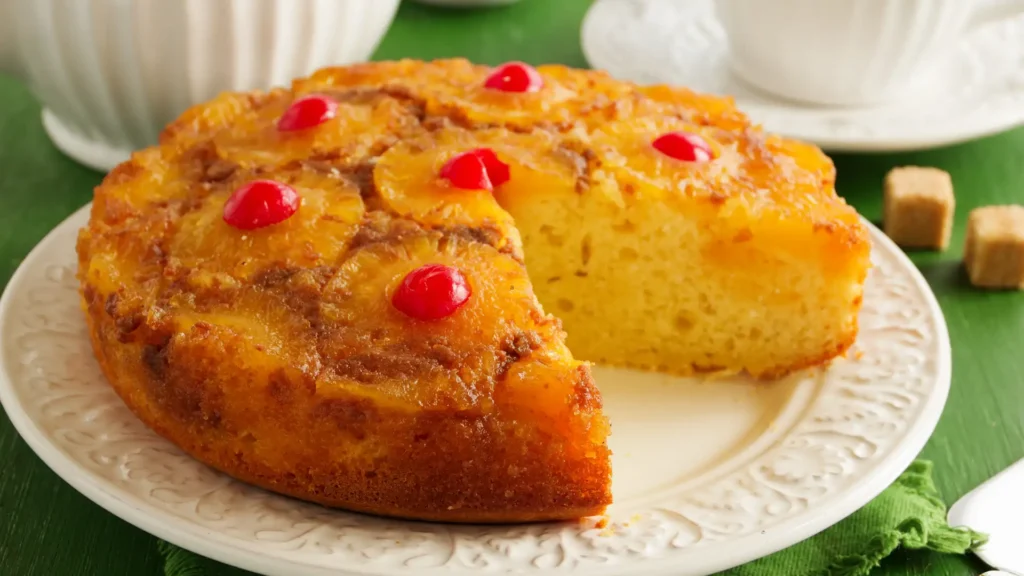
O Caramelized pineapple upside-down cake It's one of those rare confectionery masterpieces that ignores fads.
Adverts
It combines an almost rustic technical simplicity with a visual appeal that, when well executed, steals the show at any Brazilian table, from Sunday coffee to more formal celebrations.
The soul of this recipe lies not only in the sugar, but in the chemical balance between the buttery dough, which needs to be aerated enough not to collapse, and the vibrant acidity of the fruit.
It's a play of textures where the pineapple juice works to enhance the moisture, elevating the concept of "grandma's cake" to a high-end gastronomic standard.
In this guide, we'll dissect the fundamentals of caramel, the subtleties of its assembly, and the ingredient choices that define the success of this structure.
Adverts
The goal here is for you to master the art of flipping the kitchen counter safely and with a flavor that lingers in the memory.
Summary
- The Chemistry Behind Caramel
- The pineapple choice: Sweet or sour?
- Proportions and Tactical Performance
- The Secret to Pasta That Doesn't Fall Apart
- The Ritual of Unmolding
- FAQ – Real Questions
Why does caramelized pineapple upside-down cake stand the test of time?
There's something fascinating about recipes born from necessity. Upside-down cakes came into being when kitchens still relied on cast-iron skillets over the fire, long before electric ovens made our lives easier.
The concept was practical: cook the topping at the bottom so that it would protect the dough from direct heat.
O Caramelized pineapple upside-down cake It survived modernity because it uses a highly intelligent joint cooking process.
As the sugar melts, the fruit juice penetrates the pores of the dough. This creates a natural barrier against drying out, eliminating the need for artificial syrups or heavy toppings that often hide flaws in the recipe.
In the year 2026, where the search for ingredients in their purest state is the norm, this recipe becomes a manifesto.
This is not a generic dessert; it's a celebration of fruit that, under the heat, transforms into something almost liqueur-like. It's honest confectionery, visually geometric and technically impeccable.
+ Yogurt cake with lemon zest and powdered sugar frosting
How to tame dry caramel without it becoming bitter on the palate?
The biggest mistake in the foundation of this cake is the fear of sugar. Caramel demands a state of complete attention: one second less and it becomes pale and shallow; one second more and bitterness dominates everything. Temperature control is the only tool that truly matters here.
To ensure a Caramelized pineapple upside-down cake For a glassy sheen, the dry method is preferable. Gradually pour the granulated sugar into the preheated mold, observing the transition from crystalline to golden amber.
Gently move the baking pan itself to distribute the heat, avoiding the use of metal spoons which can cause unwanted crystallization.
Remember that the caramelization process doesn't stop when you turn off the heat; the metal of the mold retains heat and continues to "cook" the sugar.
Stop the melting process as soon as the toffee aroma rises, ensuring that the final coating is soft, not a hard plaque that sticks to your teeth.
To understand how the thermal stability of sugars impacts the safety and texture of food, it is worth consulting the technical notes from [source missing]. ANVISA, which detail the behavior of ingredients at high temperatures in the national context.
Which pineapple should I choose so as not to compromise the structure?
The fruit is the visual foundation of the dish, and choosing just any kind is a common strategic mistake. The Pérola variety of pineapple is usually a favorite for its latent sweetness, but it needs to be at the perfect point: ripe enough to have flavor, but firm enough to withstand forty minutes in the oven without turning into a mush.
When slicing your Caramelized pineapple upside-down cakeAim for slices one centimeter thick. Smaller than that, and the fruit will disappear; larger than that, and it will release too much water.
Removing the core isn't just an aesthetic choice; that central part is fibrous and doesn't soften completely, creating an unpleasant interruption in the slice's smoothness.
If you opt for using canned slices for convenience, you must double the care taken. Dry each slice thoroughly with absorbent paper.
Using too much artificial syrup is the quickest way to end up with a dense, heavy cake, as it throws off the liquid balance in the batter during baking.
Here is the complete technical sheet, with detailed step-by-step instructions and precise measurements to ensure that yours Caramelized pineapple upside-down cake It comes out of the oven with the structure and shine worthy of a pastry shop window.
+ Creamy pistachio tart, elegant pastry-style dessert
Classic Caramelized Pineapple Upside-Down Cake Recipe
This recipe was calculated for a round pan of 24 cm in diameterThe balance between the fruit's moisture and the dough's density is what ensures successful unmolding.
Ingredients
For the Caramel and Topping:
- 200g of refined sugar (approximately 1 and 1/4 cups)
- 1 Ripe and firm Pérola type pineapple, cut into 1 cm slices (without the core).
- Optional: Candied cherries to decorate the center of the slices.
For the Buttercream Fudge:
- 150g unsalted butter at room temperature (softened)
- 200g refined sugar
- 3 large organic eggs
- 250g sifted wheat flour
- 120ml whole milk (or coconut milk for a tropical touch)
- 1 tablespoon of baking powder
- 1 pinch of salt
- 1 teaspoon of real vanilla extract
Method of preparation
1. Caramel Base
Spread the sugar directly into the baking dish and place over low heat. Let it melt slowly until it reaches a golden amber color. Move the dish so that the caramel also coats the sides (about 2 cm high).
Remove from the heat and arrange the pineapple slices on top of the still-warm caramel. If desired, place the cherries in the gaps between the fruit. Set aside.
2. The Cremage Technique (Mass)
In a stand mixer, beat the butter and sugar for about 5 minutes on medium-high speed. The goal is to obtain an almost white and very fluffy cream. Add the eggs one at a time, beating well after each addition to ensure emulsification. Add the vanilla.
3. Incorporation of the Dry Goods
Reduce the mixer speed to the lowest setting. Add the sifted wheat flour and salt, alternating with the milk.
Do this in three steps, starting and ending with the flour. Master tip: Do not overmix at this stage; just mix until smooth to avoid developing gluten and making the cake heavy.
4. Finishing and Baking
Finally, gently mix in the yeast with a spatula. Pour the batter over the fruit in the prepared pan.
Place in a preheated oven. 180°C Bake for approximately 40 to 50 minutes. The time varies depending on the oven, so do the toothpick test in the center of the cake: it should come out clean and dry.
5. Strategic Misinformation
Remove the Caramelized pineapple upside-down cake from the oven and wait exactly 5 minutesUsing oven mitts, run a thin knife along the sides to ensure nothing is stuck. Place the serving dish over the mold and flip it over in one swift motion.
Security Note: Never try to unmold this cake when it is completely cold, as the caramel will solidify and the fruit will stick to the bottom of the pan.
Golden Tip for 2026
For an even deeper flavor, try lightly grilling the pineapple slices in a non-stick pan before placing them on top of the caramel.
This reduces the excess water content of the fruit and enhances the natural sugars, resulting in a... Caramelized pineapple upside-down cake with an irresistible smoky flavor profile.
+ Brazilian version of tres leches cake.
Table: Revenue Architecture (Actual Proportions)
| Ingredient | Technical Measure | Function in the Final Result |
| Sugar (Caramel) | 200g | Vitrification and depth of flavor |
| Fresh Pineapple | 7 to 9 slices | Contribution of acidity and natural moisture |
| Butter (Ointment Consistency) | 150g | Lipid support and aeration |
| Organic Eggs | 3 units | Protein structure and color |
| Wheat flour | 250g | Gluten development required |
The path to a mass that can support the weight of the fruit.
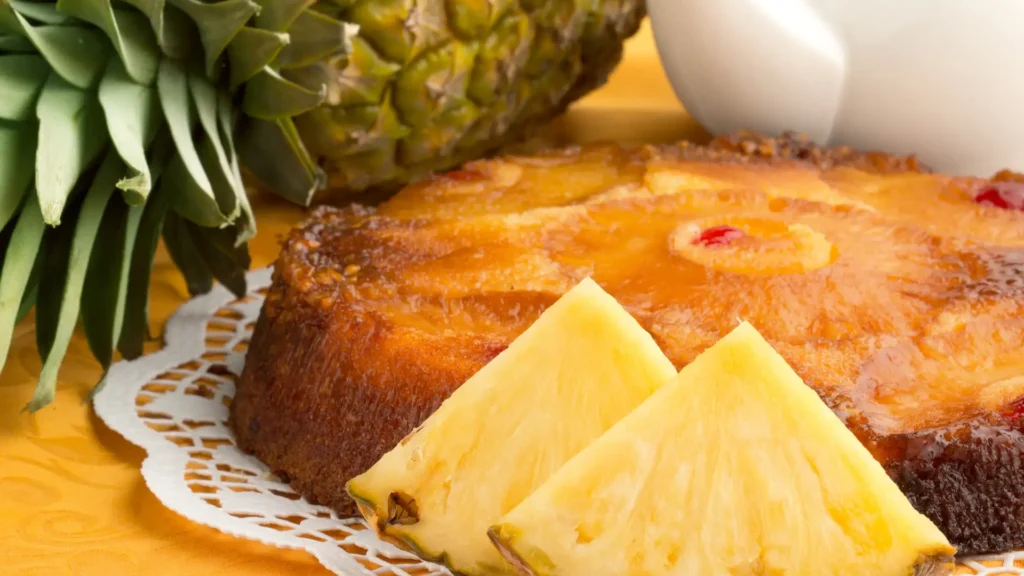
Many people underestimate the density required for this cake. The batter needs to be thick, yet light.
The secret lies in the "creaming" technique: beat the butter and sugar until the mixture loses its yellowish color and gains an almost airy volume, capturing air bubbles that will aid in expansion.
When adding the eggs, do so patiently, one at a time. If the emulsion curdles, the final texture will be grainy.
When incorporating the flour into your Caramelized pineapple upside-down cakeThe mixing motion should be from bottom to top, alternating with the milk. Do not beat the dough after adding the flour; we only want to mix it, not activate the gluten as if it were bread.
An oven with improper settings is the silent enemy here. Keep the temperature at a constant 180°C (350°F). If the heat is excessive, the caramel edges will burn before the center, heavy with the moisture from the fruit, can bake. The toothpick test should be done in the center of the batter, where the fruit juice has accumulated the most.
The golden minute: When is it safe to unmold?
There's a narrow window of time between absolute success and disaster in the kitchen. This cake cannot be unmolded when it's piping hot or cold.
If you wait too long, the caramel will turn into a permanent glue; if you wait too long, the dough, still fragile from the heat, will break.
Wait about five minutes. This is the time needed for the cake's structure to set, but for the sugar to still be in a liquid state.
Use sturdy gloves and turn your Caramelized pineapple upside-down cake In a single, decisive movement, the fruit is placed on the serving dish. Hesitation here is what causes the fruit to stick to the bottom of the dish.
If, by some oversight, the cake cools and sticks, don't try to force it with a knife. Heat the bottom of the baking pan directly over the stove flame for a few seconds.
The heat will liquefy the sugar layer again, allowing the cake to slide smoothly out without losing its original shape.
Evolution of flavor: The classic meets a modern twist.
Maintaining tradition doesn't mean ignoring creativity. Introducing elements like lemon zest or a pinch of cardamom into the dough can transform the aromatic profile, bringing a contemporary sophistication.
The contrast between the sweetness of the caramel and the freshness of the citrus zest is almost mandatory for more discerning palates.
For those seeking greater visual depth, placing candied cherries in the center of the pineapple slices creates an attractive color pattern.
However, for a Caramelized pineapple upside-down cake For a truly unique touch, try substituting regular milk with thick coconut milk. This substitution reinforces the dish's tropical character without compromising the dough's technique.
The important thing is that any addition respects the fat ratio. The balance between the fruit's moisture and the dough's absorption capacity is what differentiates a professional cake from an amateur attempt. Cooking is a science, but seasoning is pure editorial instinct.
+ Traditional Pernambuco-style rolled cake recipe
Preservation and Durability of Dessert
Due to the moist nature of fresh fruit, this cake is not meant to last for weeks. It is at its peak flavor within the first 24 hours.
If you need to store it, use an airtight cake container to prevent the dough from absorbing odors from the refrigerator, which would ruin the delicate aroma of the butter and pineapple.
If the environment is too hot, the cooling of Caramelized pineapple upside-down cake It is necessary to prevent unwanted fermentation in the fruit.
Just remember to take it out of the refrigerator at least twenty minutes before eating; the cold hardens the fat in the dough, and the cake only regains its characteristic softness at room temperature.
Freezing this preparation is a technical error. The ice breaks down the pineapple fibers, and upon thawing, the released water will flood the caramel, transforming the shiny coating into a thin, textureless syrup. Value the freshness; classic confectionery calls for immediate consumption and sharing.
Final Reflection
Preparing this cake is an exercise in patience and precision. It forces us to understand the timing of the ingredients and to respect the chemical transformation of the sugar.
O Caramelized pineapple upside-down cake It's more than a recipe; it's proof that elegance often lies in what is simple and well-executed.
By mastering these steps, you deliver not just a dessert, but a complete sensory experience that balances the rustic, the sweet, and the sour.
This type of preparation elevates any home baker to the status of an authority in the kitchen, creating a standard of quality that the reader will recognize from the first bite.
To deepen your understanding of the nutritional impact and mindful consumption of food in 2026, the guidelines of World Health Organization (WHO) They offer an essential global overview of health and well-being in modern nutrition.
FAQ – Frequently Asked Questions
Can I use frozen pineapple?
Avoid it. Frozen pineapple releases water uncontrollably during thawing in the oven, which will compromise caramelization and leave the base of your cake looking "cooked" instead of baked.
The cake broke when I unmolded it, how do I fix it?
If it's just a slice of fruit that's stuck, carefully remove it and reposition it while the caramel is still warm; it will act as a "glue." If the dough broke, the problem was probably a lack of structure in the whipped butter.
The dough turned very dark, what happened?
The caramel probably overcooked before even going into the oven, or your oven's temperature is incorrectly calibrated. Always use the center rack of the oven to ensure even heat circulation.
Is it possible to make this with other fruits?
Yes, the technique works well with apples, pears, or bananas. However, each fruit releases water at a different rate, requiring adjustments to the amount of sugar in the caramel to maintain the consistency.
What is the best type of baking pan?
Opt for high-walled aluminum or cast iron baking pans. Silicone molds are not ideal for preparing the initial caramel directly over the heat, and they don't transmit heat as efficiently for peripheral caramelization.