
How to make natural yeast and how to use it in recipes?
For those who love making a new recipe, today we're going to show you a not-so-common preparation, teaching you how to make natural yeast! So be sure to check out this article.
Adverts
Industrialized yeast sold in supermarkets (biological yeast) contains yeast in its composition, which is the same ingredient used to produce beer and alcoholic beverages.
The result of this yeast is the release of carbon dioxide and alcohol. In turn, homemade yeast (natural yeast) has some microorganisms that come from the air and also from flour, in addition to being obtained from fruits, plants and grains that are added to a lactobacillus.
This result is not like when using another variation of yeast, which has more flavor. The preparation time can last for 10 days for it to be ready, but if the weather is warmer it will be ready in less time.
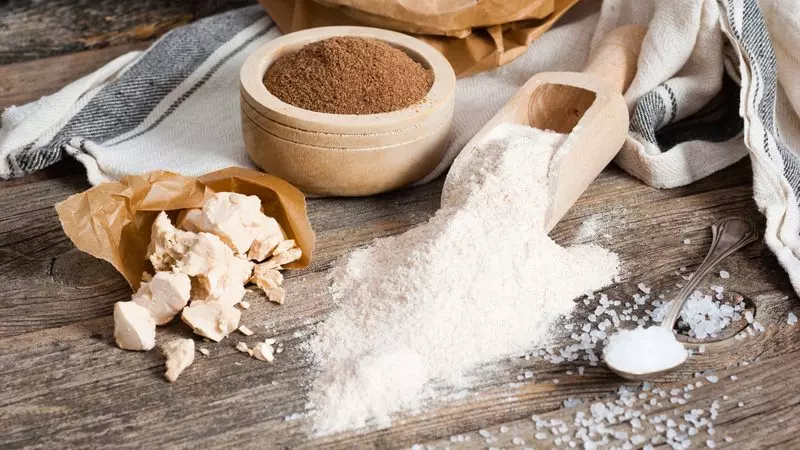
After all, what is the difference between biological and natural yeast?
In short, biological yeast, unlike natural yeast, is a single microorganism that has Saccharomyces cerevisiae (yeast), undergoing isolation and cultivation in industrialized production media, and its commercialization is done in blocks or even dried; having a characteristic of being able to contain gases to give more volume to bread, for example.
Adverts
In the case of natural yeast, it is made up of various microorganisms, not only producing carbon dioxide, but also other very interesting elements to provide consistency, color, flavor and aroma.
Here are some rules on how to make natural yeast:
Never stop using a glass container, placing it in a place that is not vibrating or that has access to sunlight. Do not use tap water, as it contains chlorine and can eliminate all the bugs.
So, make this natural yeast recipe following 5 steps.
STEP 1 ON HOW TO MAKE NATURAL YEAST
Ingredients:
- Organic whole wheat flour – 3 and 1/2 tablespoons
- Organic pineapple juice with little water – 1/4 cup (without straining)
Transfer these ingredients to a container, mix well and cover with plastic wrap. Leave a few small holes in the container and let it rest for 48 hours or until air bubbles start to form. Stir every 3 hours and cover again.
STEP 2
Ingredients:
- Organic whole wheat flour – 3 and 1/2 tablespoons
- Water – 2 tablespoons
Continue mixing and cover with new plastic wrap, make a few holes and wait between 24 and 36 hours until the new fermentation.
STEP 3
Ingredients:
- Water – 2 tablespoons
- Organic whole wheat flour – 7 tablespoons.
Mix everything again and cover with a new plastic wrap filled with small holes. The next step will be ready when the dough doubles in volume, which can take about 36 hours. Stir it three times a day.
STEP 4
Ingredients:
- Water – 2 tablespoons
- Organic whole wheat flour soup – 10 and 1/2 tablespoons.
Remove about ½ cup of the dough already made, the rest you can offer to someone else to make your own yeast or discard.
This dough tends to firm up more, if it dries out too much add more water (just a little). Then wait until it gains more volume, which can last around 24 to 48 hours.
Stay tuned! Because when part of this mass is eliminated, it is due to the reduction of the microorganisms, which is essential for a more intense proliferation to occur. However, to cause this consequence we can reduce the family and increase the food.
STEP 5
Ingredients:
- Organic whole wheat flour – 2 and 3/4 tablespoons
- Water – 1 cup
But then remove half of the dough again and add the items listed, shaping it into a ball and letting it gain more size.
As soon as the dough doubles in volume, it means that its fermentation has worked and the natural yeast for your various recipes is ready.
Although it is a time-consuming process, the result is so wonderful that now all you need to do is remove the air, form the ball and store it in the refrigerator.
Cultivation is the secret to everything
This natural yeast can be cultivated using a lot of love and patience, feeding it once a week.
So just add three parts organic whole wheat flour to three parts water, then mix everything well, and just wait for it to dry and return it to your refrigerator.
Some frequently asked questions about making sourdough
How much yeast should be used when making bread?
To do this, you need to remove the yeast from your refrigerator, separating the yeast (2 tablespoons) that is in another bowl, incorporating flour (5 tablespoons) and adding water so that it becomes a consistency like that of a creamier puree.
Then, let something grow that will help increase the action of the yeast, never forgetting to feed the part of the yeast that you removed, which you will always have.
How to feed natural yeast?
First, take some of the dough that has already fermented and discard it or use it in preparations.
Right after this is done, follow the same order of this process one more time until the yeast grows and add another 50% of flour and 60% of water for the rest, and let it ferment once more.
Pay attention to the growth inside the container and use it so that the yeast only occupies 1/3 of it, because the yeast will increase and may overflow.
Once ready, the yeast should start to bubble and have a more delicate aroma, indicating that it has activated. In fact, if the smell is not pleasant, it is recommended to discard it and start the preparation from the beginning.
Acidity is something that needs to be controlled and chosen based on how you will apply the yeast. For example, Italian breads have more acidity. This acidity control only requires paying attention to the time it takes to rise. The longer the interval between meals, the more acidity the yeast will have.
Everything you saw was practically a lesson on how to make natural yeast and how to use it in recipes, so now test all your ability to prepare it!